
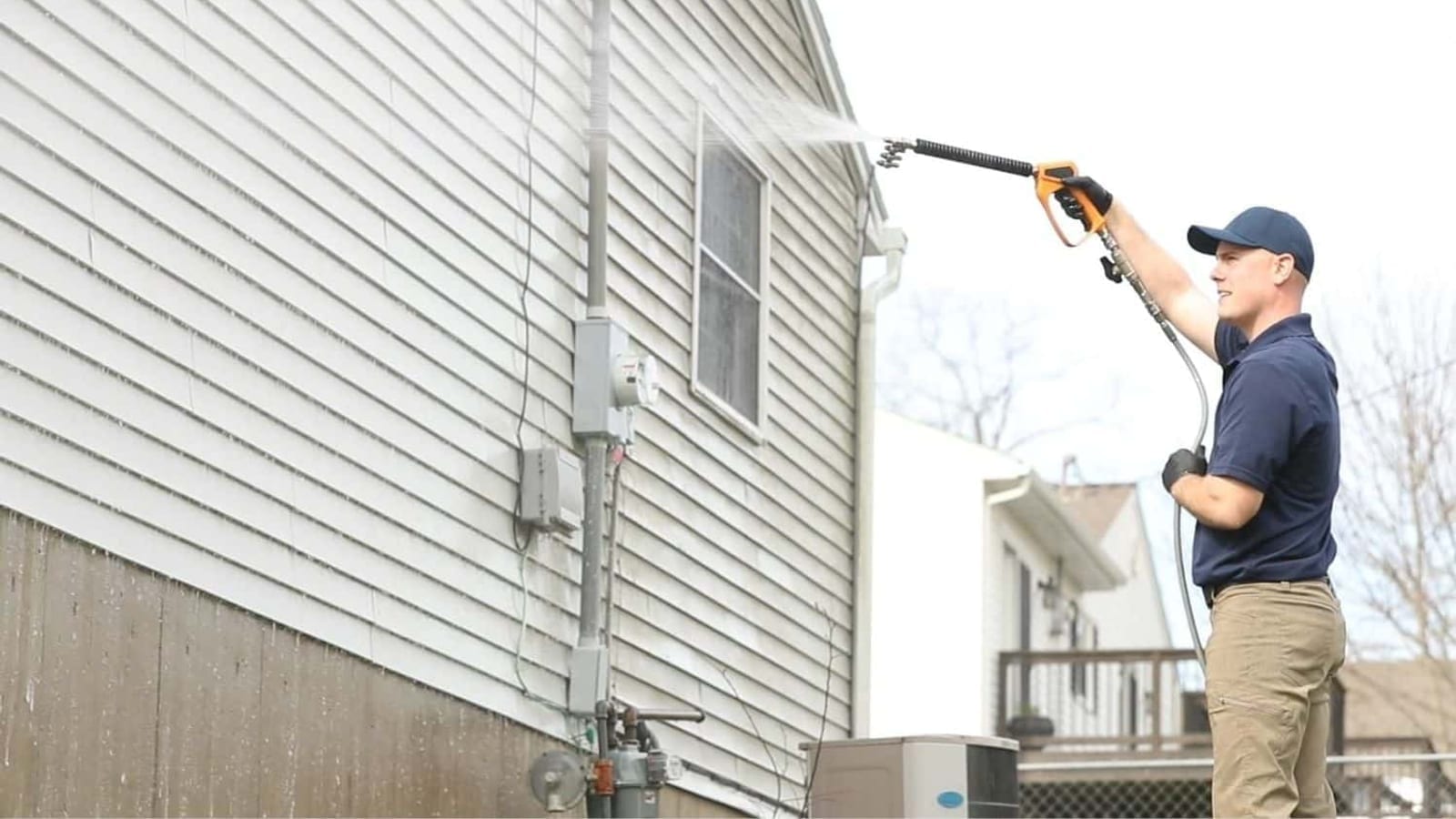
Quick answer: Softwashing is a way of cleaning a house or roof with professional, biodegradable cleaning solutions and about the pressure of a garden hose. The solution kills the algae, mildew and lichen, and a gentle rinse carries it away. You need it for anything you live under or behind, like siding, roofs and soffits. Save the pressure washer for concrete.
Softwashing is how we clean the parts of your house that a pressure washer would hurt. It uses cleaning solutions to do the work, not force, so your siding and roof come clean without getting blasted.
If you searched the word and want a plain answer, this is it. I will walk you through what softwashing is, how it differs from pressure washing, which surfaces need it, and what a proper visit looks like here in Kosciusko County and around Fort Wayne.
What is softwashing, in plain English?
Softwashing is a cleaning method with three parts: a cleaning solution, time and a gentle rinse. We apply professional, biodegradable cleaning solutions to the surface. We let them sit long enough to kill the growth. Then we rinse it all away at about the pressure of a garden hose.
The key idea is that the green film and black streaks on a house are alive. They are algae, mildew, lichen and moss. You can knock the top layer off with high pressure, but the roots stay behind and grow back. Softwashing kills the growth at the root, so the surface stays clean longer.
Think of it like washing a nice shirt. You let the soap do the work. You do not scrub it with a wire brush.
How is softwashing different from pressure washing?
The difference is where the cleaning power comes from. Pressure washing uses force. Softwashing uses chemistry and lets time do the rest.
A pressure washer runs roughly 1,300 to 4,000+ PSI. That is great for concrete, which is hard and can take it. Softwashing uses about the pressure of a garden hose, which is safe for shingles, vinyl and painted wood.
Put high pressure on the wrong surface and you pay for it. It can strip the granules off shingles, force water behind vinyl siding, etch soft brick mortar and peel paint. I go deeper on the damage in soft washing vs pressure washing, but the short version is simple. Soft wash what you live under or behind. Pressure wash what you walk on.
Which surfaces should be soft washed and which should be pressure washed?
Here is the quick guide we use on every property. If a surface is in the soft wash column, it never sees a pressure washer from our crew.
| Surface | Method | Why |
|---|---|---|
| Asphalt shingle roof | Soft wash | High pressure strips granules. The roofing industry recommends low pressure only. |
| Metal roof | Soft wash | Protects the finish and seams. |
| Vinyl siding | Soft wash | High pressure can crack panels and push water behind them. |
| Hardie board (fiber cement) | Soft wash | Protects the paint and factory finish. |
| Brick walls | Soft wash | Protects the mortar joints. |
| Stucco, cedar and painted wood | Soft wash | Soft surfaces gouge, splinter or peel under force. |
| Soffits and fascia | Soft wash | Thin material and lots of nooks for water to get into. |
| Driveways and sidewalks | Pressure wash | Concrete is hard enough to take the force. |
| Patios and brick flatwork | Pressure wash | Ground level surfaces built to be walked on. |
Our rule: Elite Softwash never pressure washes a roof. The Asphalt Roofing Manufacturers Association recommends low-pressure cleaning only for asphalt shingle roofs, and we follow that every time.
Why do northern Indiana homes need softwashing?
Our part of the state grows things on houses. Shade, tree cover and lake humidity keep surfaces damp, and damp surfaces feed algae and mildew. That is why the north side of a house usually turns green first.
Around the lakes in Syracuse, Winona Lake and Warsaw, the humidity is higher still. Lake homes tend to show black streaks on the roof and a green film on the shady walls sooner than homes out in open fields.
Those black streaks on a roof are an algae called Gloeocapsa magma. It feeds on the limestone filler in shingles. You cannot rinse it off with plain water, and you should not try to blast it off. You have to kill it, which is exactly what softwashing does.
Fall matters too. Growth that sits on your siding through a wet winter of freeze and thaw just digs in deeper. A late fall wash sends the house into winter clean, and we work year-round around your schedule.
What happens during a softwash visit, step by step?
A proper softwashing visit follows the same order every time. Here is what you should see when our crew shows up.
1. Walk the property
We look at the siding, the roof, the landscaping and anything delicate like outdoor lights, vents or a koi pond. We note where the growth is heaviest so we know where the solution needs the most time.
2. Rinse and protect the landscaping
Before any solution goes on, we soak your plants, shrubs and grass with clean water. Wet plants do not soak up overspray the way dry ones do. We also close windows and cover anything that needs it.
3. Apply the cleaning solution
We apply professional, biodegradable cleaning solutions at low pressure. On siding, we work from the bottom up so the solution does not streak. On roofs, we apply from a safe angle without walking on shingles any more than needed.
4. Let it dwell
This is the part people do not expect. We let the solution sit and work. You will often see the green fade and the black streaks lighten while we wait. Rushing this step is how growth comes back fast.
5. Rinse at low pressure
We rinse the house from the top down with gentle water. Then we rinse the landscaping again, thoroughly. Last, we walk the property with you, and if you are not happy, the job is not done.
If you have a visit coming up, our page on how to prepare for your upcoming service covers what to move and what to leave alone.
Is softwashing safe for plants, pets and roofs?
Yes, when it is done right. Our cleaning solutions are 100% biodegradable, and we pre-rinse and protect your landscaping before we start and rinse thoroughly afterward. That before and after rinse is what keeps flower beds and shrubs looking healthy.
For pets, we ask that you keep them inside while we work and until things are rinsed. It keeps them out from under ladders and away from the hoses. For lake homes, our crews clean without harming the landscaping or the water.
For roofs, softwashing is the safe choice. Low pressure is the method shingle manufacturers recommend. If you have questions about your own roof warranty, check your manufacturer documentation.
How do you find softwashing near me that is done right?
Plenty of people own a pressure washer. Fewer know when to put it away. When you are calling around for softwashing near you, a few questions sort things out quickly.
- Do you ever pressure wash roofs? The only right answer is no.
- How do you protect my landscaping? Listen for a pre-rinse and a rinse after.
- Are you licensed and insured? Ask to see it.
- Do you back the work? Look for a warranty and a satisfaction guarantee.
- Will you give me a real quote? It should be specific to your house, not a guess.
Here is what a bad job looks like. A rental pressure washer on the roof. Siding with tiger stripes or water marks where the wand got too close. Brown spots in the flower beds a week later. Nobody to call when the streaks come back. Our guide on how to hire a pressure washing company you can trust has a full checklist.
Elite Softwash is fully licensed and insured, and every job is backed by a warranty and a 100% satisfaction guarantee. We are a family business based in Silver Lake, and I work alongside my two sons on these jobs. We serve Warsaw, Winona Lake, Syracuse and Lake Wawasee, North Manchester, Columbia City, Leesburg, Milford, Huntington, Auburn and the greater Fort Wayne area. You can see the full details of our house washing service.
Ready to get your property cleaned?
Related guides
Frequently asked questions
is softwashing worth it
For siding and roofs, yes. Softwashing kills algae, mildew and lichen at the root instead of just knocking off the top layer, so the house stays clean longer. It also avoids the damage high pressure can do to shingles, vinyl and paint, which is far more costly to fix than a wash.
how long does softwashing last
It depends on shade, trees and how close you are to a lake. We tell customers most homes benefit from a house wash once a year and a roof soft wash every two to four years. Shaded and north facing surfaces grow algae faster, so those spots may need attention sooner.
can i softwash my own house
You can try, but it is harder than it looks. Getting the solution strength right for each surface, protecting plants and working safely on ladders and roofs all take experience. Mistakes can mean dead shrubs, streaked siding or a fall. If you do it yourself, never use a pressure washer on siding or shingles.
softwash vs power wash which is better
Neither is better everywhere. Softwashing is right for roofs, siding, soffits, stucco and painted wood. Power washing is right for concrete driveways, sidewalks, patios and brick flatwork. A good company uses both and picks the method based on the surface.
softwashing near me kosciusko county
Elite Softwash is based in Silver Lake, minutes from most of Kosciusko County, and serves the lake communities and the greater Fort Wayne area. Send us your address or a few photos for a free quote, usually the same day, or call (260) 802-0297.
About the author: Brandon Metzger. Owner of Elite Softwash, a family owned exterior cleaning company based in Silver Lake, Indiana, serving Kosciusko County, the lake communities and the greater Fort Wayne area.

